Road Construction Highway 89 California
This segment is the original (b) from 1963.
See the "FREEWAY" section below for information on proposed freeway routings for this section.
In 1934, Route 89 was signed along the route from Jct. Route 7 (US 395) near Coleville to Jct. US 99 (I-5) near Mt. Shasta, via Truckee, Quincy, and Chester. This segment was part of LRN 38, defined in 1911. Originally, Route 80 (I-80) was US 40.
In June 2017, it was reported that a late 1955 massive rock and earth slide that engulfed Route 89 and tumbled all the way down to Emerald Bay, forcing an 11-month road closure, prompted Tahoe business leaders to push for highway improvements to to expand the Tahoe year-round economy. Some talked of a San Francisco-sized population in the basin. "It became evident," a state Division of Highways analyst wrote, "that a better route would have to be found to get past Emerald Bay (~ ED 14.802 to ED 18.625). The present road is narrow and crooked and impossible to keep open during the winter." Their notion: An Emerald Bay Bridge. The state Division of Highways, the precursor to today's Caltrans, hired geologists, studied alignments, drew up engineering plans, and built a scale model of an arched bridge, low to the water, to show at community meetings. Officials even commissioned a serene watercolor artwork of the bay fronted by a bridge that looked almost dainty on the landscape. The debate was instantaneous, with strong arguments on both sides. Proponents pointed to the Golden Gate Bridge, which was called beautiful and tourists flocked to it. The Sacramento Bee and others were aghast. In a 1956 editorial, The Bee called the bridge "a tragic mistake bordering on a crime." State parks officials said the bridge express road would mar not only Emerald Bay State Park but also would slice through nearby D.L. Bliss State Park. The bridge was not the only major road change officials considered at the time. The state also proposed a wider and straighter mountain road above the bay that would run through a long mountain tunnel. The debate – and the planning – continued into the mid-1960s. But the idea was beginning to lose its footing. Bridge opponents got an assist from an unlikely source, new Gov. Ronald Reagan. Reagan appointed William Penn Mott Jr. as state parks chief. Mott came out against the bridge. Two events were pivotal in its demise. In 1968, a regional planning group formed by California and later joined by Nevada, now called the Tahoe Regional Planning Agency, put together its first Tahoe growth plan that year and declined to include the state's Emerald Bay Bridge project in it. Soon after that, a state committee assembled by Reagan with Mott as a key member shelved the plan. The following year, Emerald Bay was designated a National Natural Landmark.
(Source: Sacramento Bee, 5/28/2017)
[SHC 253.1] Entire route. Added to the Freeway and Expressway system in 1959.
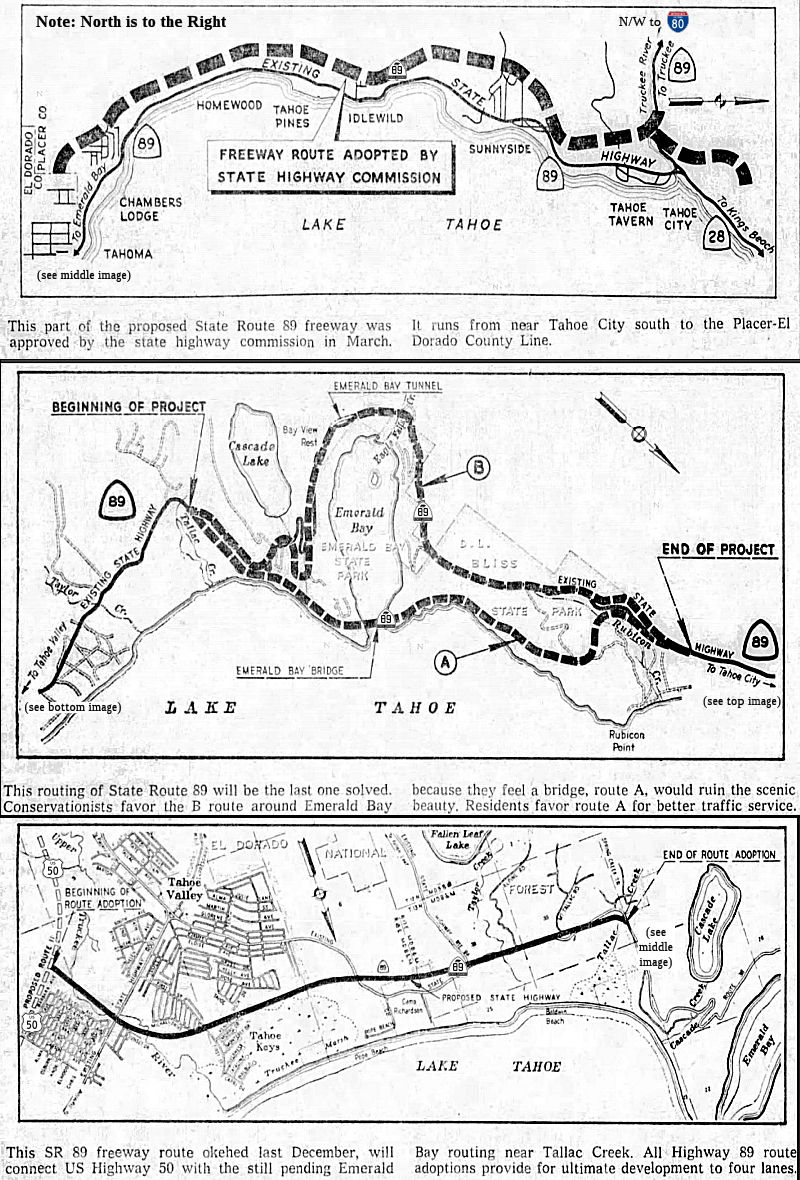 Joel Windmiller posted in the California's Historic Highways FB group the following images of the freeway route adoptions along this segment that were published in June 1963:
(Source: Joel Windmiller/California's Historic Highways (FB), 6/2/2020)
Route 50 near Mays Junction to the Northern End of Lake Tahoe (Route 28)
US 50/Route 89 Roundabout (03-ED-89, PM 8.592)
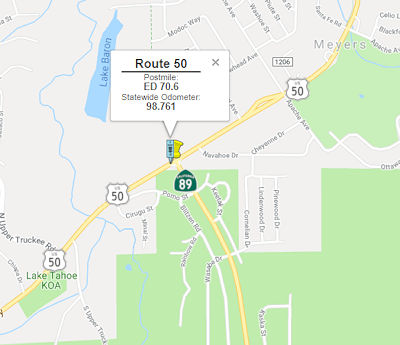 In March 2017, the CTC approved for future consideration of funding a project located in El Dorado County near the town of Meyers (03-ED-89, PM 8.592; 03-ED-50 PM 70.62) that proposes to convert the US 50/Route 89 intersection into a three-leg roundabout. The proposed roundabout will have single lane approaches on all three legs to reduce the number and/or severity of collisions. This project is programmed in the 2016 SHOPP for $5,240,000 in Construction (capital and support) and Right of Way (capital and support). Construction is estimated to beginning in Fiscal Year 2017-18. The scope, as described for the preferred alternative, is consistent with the project scope programmed by the Commission in the 2016 State Highway Operation and Protection Program.
In May 2018, it was reported that a three-year, $56.9 million project (2018 is the second year) involves rebuilding a 2-mile stretch of U.S. 50 from the "Y" with Route 89 (03-ED-89, PM 8.592; 03-ED-50 PM 70.62) to Trout Creek Bridge (ED 077.33). The rebuilding includes widening the roadway to provide 6-foot shoulders for bike lanes in both directions, replacing traffic signals, rebuilding curbs, gutters and sidewalks, and improving the pavement cross slope, according to Caltrans. Aside from aesthetic improvements, the project also is designed to help lake clarity by building drainage systems to treat stormwater runoff. It is part of the larger Lake Tahoe Environmental Improvement Program, a multi-agency effort created to protect and improve the natural and recreational resources of the Lake Tahoe Basin. Work in summer 2018 will stretch from Winnemucca Avenue to Silver Dollar Avenue, in addition to repaving the Y intersection, according to Caltrans. Work will start at Winnemucca and move east.
(Source: Tahoe Daily Tribune, 5/2/2018)
In June 2018, the CTC was informed of the following allocation: 2.5f(3) Item 2: $4,973,000 03-ED-50 70.6. PPNO 3303. US 50 Near Myers, at the intersection with Route 89 South. Outcome/Output: Improve safety by constructing a 3-leg roundabout with a bypass lane in the westbound direction at a two-way stop controlled intersection. This project will reduce the number and severity of collisions.
In November 2018, it was reported that in the 2018 construction season, Caltrans completed Phase Two of the three-phase "Y to Trout Creek Bridge Project" that is reconstructing US 50 from the "Y" intersection with Route 89 to the Trout Creek Bridge. Phase Two focused on the stretch of highway from Winnemucca Avenue to Silver Dollar Avenue. As part of the Lake Tahoe Environmental Improvement Program, this project was designed to protect Lake Tahoe's water quality by rebuilding underground storm drain systems. Now, storm water runoff is captured and filtered to keep dirt, oil and litter from reaching the lake. Additional community benefits include widening the highway to provide 6-foot shoulders for safer bike access as well as new traffic signals at the intersection of Lodi Avenue and US 50. Sidewalks on both sides of the highway have also been reconstructed. In 2019, the final phase of the Y to Trout Creek Bridge Project will focus on Phase Three, from Silver Dollar Avenue to the Trout Creek Bridge, with a projected completion date of winter 2019. 2019 will also bring work in Meyers, where Caltrans will replace the existing T-intersection at Route 89 and US 50 with a three-leg roundabout. Currently, the junction just past the weigh-in station does not have traffic stops controlling vehicle flow. This project was designed to improve safety and reduce the number of collisions at the intersection.
(Source: Tahoe Daily Tribune, 11/11/2018)
In April 2019, it was reported that the project will also include a westbound bypass lane, and should be completed in Fall 2019.
(Source: Tahoe Daily Tribune, 4/23/2019)
In September 2019, it was reported that the Caltrans contractor working on the roundabout at the intersection of Route 89 and US 50 has completed concrete work on the bypass lane. The $4.1M project converted a T-intersection into a three-leg roundabout with a bypass lane.
(Source: South Tahoe Now, 9/6/2019)
In May 2018, it was reported that, following backlash in its first summer of use and input from partner agencies, the pedestrian stoplight at Camp Richardson is on indefinite hiatus. The device was installed in 2016 as part of a Caltrans construction project. It was mostly used in the summer of 2017 as a means to help address traffic and pedestrian issues. However, the light, which displayed a red signal to motorists when pedestrians activated it to cross Route 89, was scrutinized by residents and others who blamed the signal for worsening vehicle congestion. The light was deactivated around the Fourth of July holiday (presumably in 2017, unless the author had time travel), when, according to Caltrans, a significant increase in motorist and pedestrian activity led to congestion in the area. Caltrans "decided to discontinue" the light "indefinitely" after meeting with staff from the Tahoe Regional Planning Agency and U.S. Forest Service. The light will remain off until the Route 89 Recreation Corridor Management Plan is completed in 2019.
(Source: Tahoe Daily Tribune, 5/20/2018)
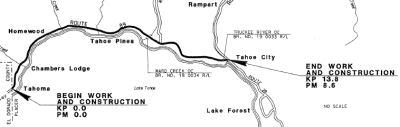 There are plans to construct roadway improvements between the El Dorado County Line (~ ED 27.8/PLA 0.0) to Route 28 (~ PLA 8.276). This project is fully funded in the 2006 SHOPP. The total estimated project cost is $85,300,000. Construction is estimated to begin in FY 2007-08. The project will involve the removal of mature vegetation and the disturbance of existing wetlands. In addition, changes in the visual character of the area in the form of new lighting resulted in a Mitigated Negative Declaration being completed for this project.
Water Quality Improvement
In October 2011, the CTC approved $40,413,000 for a project in Tahoe City from 0.2 mile south of the El Dorado/Placer County Line (~ ED 27.181) to the Truckee River Bridge (~ PLA 008.48). The project will construct water quality collection and treatment facilities to meet the requirements of California Regional Water Quality Control Board. (Construction will take more than 3 years due to permit restriction on grading and soil disturbances between May1 to October 15 each year. Also, traffic restrictions are reduced between June 15th and Labor Day during the peak tourist season. Construction is estimated to begin Summer of 2012 and be completed by December 2015. As a result, the California Department of Transportation is also requesting 39 months to complete construction.)
In January 2012, the CTC approved for future consideration of funding a project in El Dorado County will implement water quality improvement measures on Route 89 from US 50 to Cascade Road in and near South Lake Tahoe. These improvements will comply with the National Pollutant Discharge Elimination System Permit requirements and implement elements of the Lake Tahoe Environmental Improvement Program. The project is programmed in the 2010 State Highway Operation and Protection Program (SHOPP). The total estimated project cost is $30,023,000 for capital and support. Construction is estimated to begin in Fiscal Year 2012-13. The scope, as described for the preferred alternative, is consistent with the project scope programmed by the Commission in the 2010 SHOPP.
In April 2016, it was reported that work was resuming on a multi-year Route 89 project. The $70.1 million water-quality improvement project is building new drainage facilities to collect and treat stormwater runoff, adding curbs and gutters, widening the highway and repaving an eight-mile section of Route 89 between Tahoma and Tahoe City. Work in the 2016 construction season focuses on the remaining four miles of the project between Eagle Rock and Granlibakken Road. Caltrans has two other water-quality improvement projects on Route 89 that will be in construction in 2016 as part of the multi-agency Lake Tahoe Environmental Improvement Program (EIP). A $24.4 million project from the "Y" intersection with US 50 in South Lake Tahoe to Cascade Road, north of Camp Richardson, is in its second season of construction and will be completed in fall 2016. Picking up where that project ends, the final segment of Route 89 to be rebuilt for drainage improvements will be from Cascade Road to just north of the Eagle Falls Viaduct over Emerald Bay. The $13 million project will take two seasons to construct. In addition to the EIP projects, Route 89 from Tahoe City to Alpine Meadows Road will be repaved this summer as part of ongoing preventive maintenance.
(Source: Tahoe Roads, April 2016)
Fanny Bridge Project (Jct Route 89/Route 28) (~ PLA T8.542)
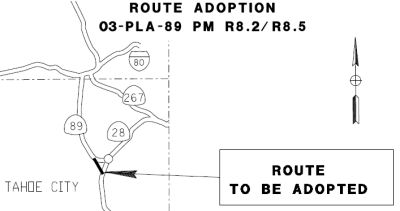 It was also reported in September 2011 about plans to reconstruct the Fanny Bridge. The bridge was constructed in 1920 and spans the Truckee River, Lake Tahoe's sole outlet, near the at-times very congested pedestrian intersection at the Wye intersection in Tahoe City. The project would rehabilitate Fanny Bridge, while simultaneously addressing traffic congestion. Preliminary plans feature four alternatives. Initially, the preferred option calls for construction of a four-lane bridge to span the Truckee River farther west from the current Fanny Bridge location. The bridge would be part of a new road that would serve as the main ingress/egress route connecting Route 89 and Route 28. Roundabouts also would be installed at each intersection. Meanwhile, Fanny Bridge's structural deficiencies will be addressed, and the remaining stretch of Route 89 from the Wye to the intersection of the newly built road will be transformed into a local neighborhood street, with a variety of traffic calming features designed to dissuade motorists from using the path as a primary means of travel. The other three alternatives include changing the existing Route 89 just south of Fanny Bridge into a pedestrian/bike trail; installing a cul-de-sac at the end of that street; or conducting the project without roundabouts, respectively. Planning level cost estimates call for a $13-18 million investment. The project is slated to continue to solicit community input and feedback throughout 2011 and develop a final design by 2012. Construction is tentatively scheduled to commence in 2014.
In August 2016, the CTC approved for future consideration of funding a project that realigns a segment of Route 89 with a replacement bridge and various other improvements including a roadway section replacement, pedestrian and bicycle improvements, roundabouts, and a complete streets element to address traffic, bicycle and pedestrian congestion (03-PLA-089 R8.2/R8.5). On April 10, 2015, the TDD adopted the FEIR for State Route 89 / Fanny Bridge Community Revitalization Project under CEQA. On July 15, 2016, the TTD confirmed that the FEIR remains valid and that there are no new identified impacts requiring mitigation since adoption. The TTD also confirmed that the preferred alternative set forth in the final environmental document is consistent with the Project scope of the work programmed by the Commission. The Project is estimated to cost $38,877,000 and is fully funded through construction with Federal Land Access Program (FLAP) Funds ($30,620,000), Active Transportation Program Funds ($4,900,000) and Local Funds ($3,357,000). Construction is estimated to begin in Fiscal Year 2016/17.
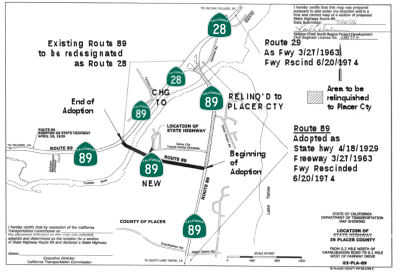 At the same meeting, the CTC also approved Federal Highway Administration's Central Federal Lands Highway Division (CFLHD) plans, in conjunction with Tahoe Transportation District (TTD), to construct a new alignment for portion of Route 89 near Tahoe City through United States Forest Service (USFS) property. This new alignment will better serve the west shore communities of Lake Tahoe by providing an option for the traveling public as they approach Tahoe City from the south and from the west. The purpose of the route adoption is to improve safety and operations of the existing Route 89/Route 28 intersection, improve multimodal access with the creation of "complete streets" elements, address long term bridge integrity by replacing the aged Fanny Bridge, and contribute to economic revitalization by enhancing motorized and non-motorized business access and safety, including delivery of goods and services. This project brings about the highest and best beneficial uses of USFS land and its associated modes of travel. The adopted route will serve as a parallel route for the traveling public entering or exiting the hub of Tahoe City. Route 89 serves the west shore communities of Lake Tahoe, crosses the Truckee River at Fanny Bridge and connects to Route 28 in Tahoe City, also known as the WYE intersection, before continuing to the town of Truckee, California. Approaching the WYE intersection from all three directions, this two-lane conventional highway has historic congestion during the summer peak season with an unacceptable Level of Service (LOS) "F". The urban context of the WYE intersection in Tahoe City adds to the congestion. During emergency response to fire, police, or ambulatory calls, there is delay for emergency crews to clear the WYE intersection. The physical and environmental setting severely constrains any lane addition, or bridge widening options to mitigate for the LOS "F". The current single route over the Truckee River has proven to be inadequate given the aforementioned constraints. Bicycle and pedestrian activity are very close to travel lanes on and around Fanny Bridge. Safety risks to pedestrian, bicycle, and motorists result from inadequate multi-modal infrastructure related to discontinuous bicycle paths, and the absence of pedestrian facilities, compounded with heavy volumes of vehicular traffic, pedestrian activity, and trail use. Current traffic congestion and inadequate travel conditions in and around Fanny Bridge and the WYE intersection are the primary reasons for the proposed realignment of Route 89. In addition, this project also replaces the 1928 Fanny Bridge. The two new intersections created by the new alignment, plus the existing WYE intersection, will become roundabouts. These three roundabouts will provide a decrease in traffic congestion and will accommodate multiple modes of transportation in a safe manner. After construction of the new Route 89 alignment, and with the Commission's approval, a small portion of this route will be redesignated as Route 28 extension and a segment of the existing Route 89 from north of Fanny Bridge to the new intersection south of the bridge will be relinquished to the County. The County has signed a relinquishment agreement and is receiving a transfer of possession and control of the new Fanny Bridge as part of their inventory, post construction. State highway adoption of Route 89 occurred on April 18, 1929. Freeway adoption of a portion of Route 89 occurred on March 27, 1963. Rescinding of Freeway Declaration for said portion of Route 89 occurred on June 20, 1974. Route 89 is part of the Freeway and Expressway System. CFLHD is contributing $30.62 million and TTD with the County are contributing a combined total match of $8.257 million.
In July 2018, it was reported that construction on the new Truckee bridge had started, with expected completion in October 2018. The project, originally conceptualized in the 1994 Tahoe City Community Plan, is a new Truckee River bridge — a rebuild of Fanny Bridge. The construction of three new roundabouts, the realignment of Route 89 to match new road plans, and other street improvements along West Lake Boulevard are all part of the bridge project. The new Truckee River Bridge, located east of the Caltrans maintenance yard along Route 89 and downstream of Fanny Bridge, will become the new junction between Route 89 and Nevada Rte 28. The 88-year-old Fanny Bridge will be rebuilt to include new sidewalks and bike lanes on each side, with bridge railing that matches the existing design. A new roundabout will be constructed on the north side of the Truckee River with outlets onto the new bridge and West River Street. Another roundabout will connect a new route from the new bridge to West Lake Boulevard. The third roundabout will replace Tahoe City's busiest intersection where the original junction between Route 89 and Route 28 currently stands. West Lake Boulevard also will receive improvements including new sidewalks, crosswalks, street lights, and street and trail signs. Two new Tahoe City gateway signs will be installed at the two roundabouts leading into the city. The Tahoe City Trout Sculpture has already been dismantled and moved to storage to allow for construction. City officials are still making efforts to secure a new location for the sculpture when the project is complete.
(Source: Sierra Sun, 6/28/2018)
In October 2019, it was reported that the project to replace the Truckee River "Fanny" Bridge, enhance pedestrian mobility, improve access to public transit and relinquish a section of Route 89 to Placer County is planned for 2021. Short-term work at the "Wye" intersection to reestablish pedestrian access and erosion control is scheduled to be completed by the end of October 2019.
(Source: Caltrans District 3 Press Release, 10/28/2019)
In December 2019, it was reported that Caltrans joined several partner agencies for a ribbon-cutting ceremony on the new Route 89 Truckee River Bridge in Tahoe City. The project includes roundabouts at each end of the bridge and new bike path segments.
(Source: Facebook, 12/16/2019)
Northern End of Lake Tahoe (Route 28) to Truckee (I-80)
Tahoe to Truckee Repaving
In September 2011, it was reported that a portion of Route 89 connecting Tahoe City to Truckee will be repaved, shoulder to shoulder. The project will begin in Spring 2012, taking one construction season to complete. Funds from the California State Highway Operation Protection Program will be used. Repaving will start 0.2 miles south of the Squaw Valley USA exit (~ PLA 13.725) and end at the Nevada County state line near Truckee.
In March 2012, the CTC approved SHOPP funding for work near Truckee, from 0.2 mile south of Squaw Valley Road (~ PLA 13.515) to Nevada County line (~ PLA 21.642/NEV 0.0). $8,360,000 to rehabilitate 16 lane miles of pavement to improve ride quality and extend the pavement service life.
In October 2012, it was reported that the shoulder to shoulder repaving project on Route 89 between Squaw Valley Road to West River Street was completed. The $7.2 million project between Truckee and Olympic Valley improved the surface for bikes and motor vehicles, and included water quality protection from stormwater drainage while extending the pavement life an additional 10 years.
In August 2019, it was reported that, to help reduce peak ski weekend traffic congestion into Squaw Valley and Alpine Meadows resorts, the county is considering converting the road shoulders on Route 89 into a third lane only accessible by public transit vehicles, encouraging the use of those services. The project consists of two 2-mile bus-on-shoulder zones in the highest congestion areas, specifically northbound beginning north of Cabin Creek Road (~ PLA 18.956) to the West River Street intersection (~ PLA 21.526) and southbound beginning south of the Pole Creek Trailhead (~ PLA 16.042) to the Squaw Valley Road intersection (~ PLA 13.727). The schedule is dependent on Caltrans and California Highway Patrol approval but is tentatively planned for winter 2019. If successful, the program could lead to an extension to the full section of Route 89 between Olympic Valley and Truckee, and possible application on Route 267 between Northstar and Truckee.
(Source: Tahoe Daily Tribune, 8/14/2019)
In June 2016, it was reported that the Truckee North Tahoe Transportation Management Association is starting discussions for a potential three-lane program on Route 89 for the 2016-17 winter season in an effort to ease traffic congestion. The program would be based on an existing program on other roads that routes two lanes of traffic inbound to Squaw Valley during the morning hours and two lanes outbound in the afternoon. Physically speaking, fitting three lanes on Route 89 is possible, as Route 89 pinch points are 42 feet. Hurdles for the program include traffic control, snow removal and condensed shoulder space. The program is viewed as a limited experiment only used when there is no snowfall and the shoulders are clear, similar to the preconditions used for the three lanes at Squaw Valley Road (dry roadway surface, full road width).
(Source: Sierra Sun, 6/14/2016)
The SAFETEA-LU act, enacted in August 2005 as the reauthorization of TEA-21, provided the following expenditures on or near this route:
- High Priority Project #234: Widen Route 89 at the existing "mousehole" two lane RR underpass in Truckee (~ NEV 0.135). This has been a crusade of Rep. John Doolittle, according to the Sierra Sun. The narrow tunnel is heavily used by pedestrians headed to the Crossroads shopping center and bicyclists heading up and down Route 89. The Town of Truckee has taken the lead on the complicated project that involves Caltrans, Union Pacific Railroad, Nevada County and to some extent Placer County. Widening the existing passage, or building a second undercrossing, is saddled with the extra challenge of completing the work while railroad traffic continues on the tracks above. $2,827,744
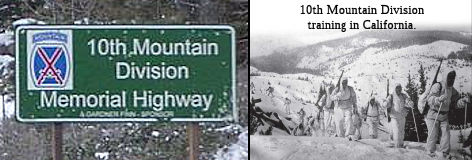 The portion of the route between Truckee and Tahoe City is named the "10th Mountain Division Memorial Highway". The 10th Mountain Division of the United States Army, consisting of 15,000 soldiers, served gallantly in the Italian campaign during World War II. It had many members from Sierra County. After the war, ex-soldiers from the 10th Mountain Division fired-up America's modern ski industry. They published ski magazines, opened ski schools, and established ski areas, including Vail, Aspen, Sugarbush, Whiteface Mountain and others. At least 62 ski resorts have been founded, managed, or employed head ski instructors that were 10th Mountain Division veterans Named by Senate Concurrent Resolution 43, Chapter 106, in 1997.
(Information source: The Storm King; Image source: James D. Teresco/Ride from Auburn to Squaw Valley, California, Snow Brains)
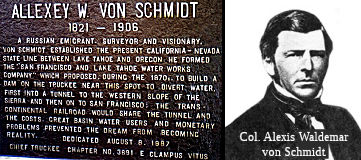 Near Alpine Meadows Road is the "Allexey Waldemar Von Schmidt Historical Plaque". It was designated by Senate Concurrent Resolution 75, Chapter 105, in 1992. Allexy Waldemar Von Schmidt was a 19th century Russian immigrant and civil engineer whose survey helped establish the border between California and Nevada. Von Schmidt arrived in San Francisco in 1849, but did not join the gold rush. Trained as a civil engineer at American universities, Von Schmidt landed a job as a United States surveyor, mapping public lands and Spanish land grants throughout the state. Recognizing that "water flows uphill to money" and that a limited fresh water supply threatened to curtail the growth of San Francisco, Von Schmidt helped incorporate the Bensley Water Company. The company successfully built San Francisco's first water supply system in the late 1850.. He later joined the rival Spring Valley Water Company, and five years later, Spring Valley bought out the Bensley outfit and established a profitable monopoly as the principal water purveyor to San Francisco. In 1865, Von Schmidt and five other investors established the Lake Tahoe and San Francisco Water Works Company to export the water of Lake Tahoe to the Bay Area, a distance of 163 miles. When Von Schmidt's proposal was submitted to legislators in Sacramento and Washington, D.C., it ran into strong resistance. Opponents argued that the federal government had no business subsidizing private corporations by giving away public lands.
(Image source and additional information: Sierra College)
Source: https://www.cahighways.org/ROUTE089.html
Posted by: harviliczjamikaaye.blogspot.com


Posting Komentar untuk "Road Construction Highway 89 California"